Track every frame.
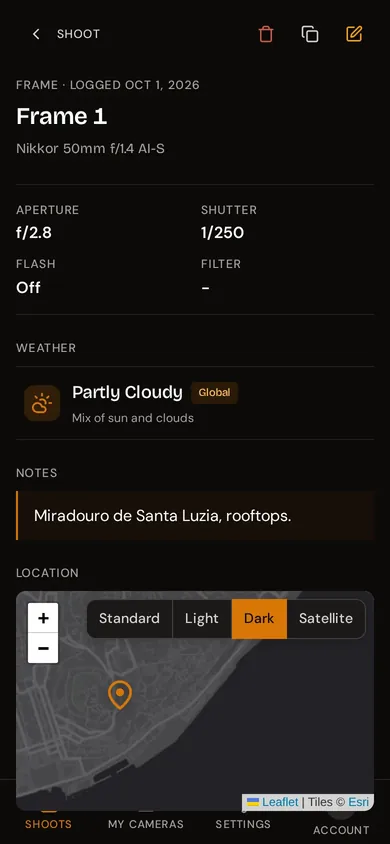
A field notebook for analog photographers. It logs every setting of your camera, and even your location when you took the shot so that nothing is lost between the shutter and the lab.
Film doesn't forgive
bad notes.
You pressed the shutter at f/5.6, 1/500, on Portra 400 but that was three weeks ago and you just got the roll back.
rollnote is the notebook you never carry. 30 seconds per frame. Everything you shot, exactly as you shot it, waiting for the negatives to come back.
- Per frame
- 30 seconds
- Film library
- 50+ stocks
- Free
- Forever
One tap.
Every setting.
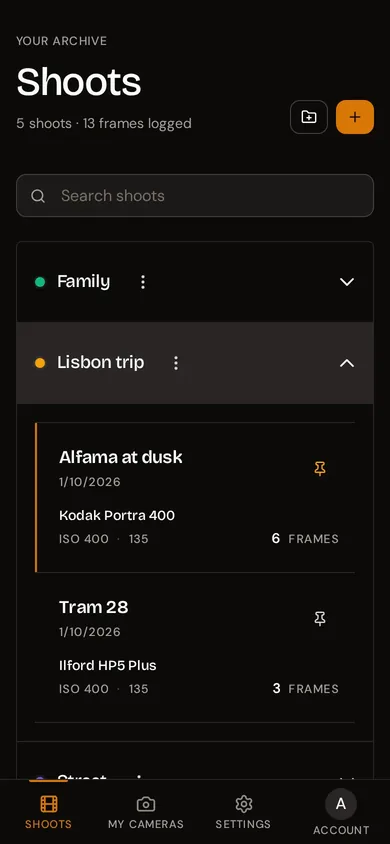
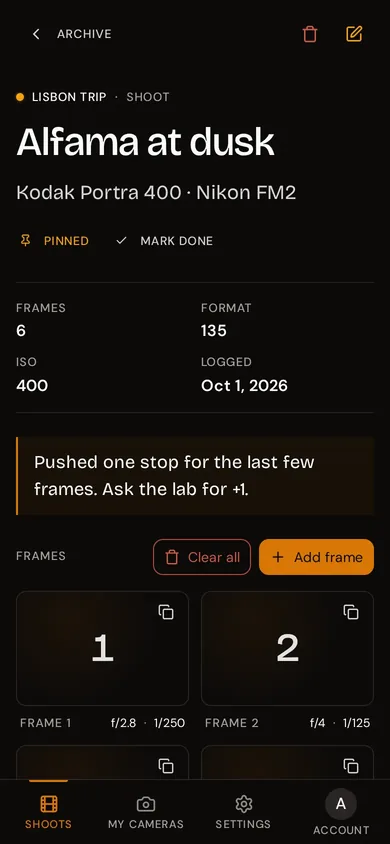
Built for the hand holding the camera. The form hides everything you don't need so you can log a frame as quickly as possible.
Four reasons to
try rollnote.
- 01
Built for film.
Every field exists because film photographers asked for it. No digital bloat, no platform features borrowed from Lightroom or Instagram. The form assumes you shoot rolls.
- 02
One-handed.
The logging flow is designed for a camera in one hand and a phone in the other. Large tap targets, sensible defaults, and each frame logged in 30 seconds.
- 03
Nothing is locked.
Add any film stock, any lens, any custom weather condition, any obscure filter. The app bends to your practice.
- 04
Free. Forever. As it should be.
Built by a photographer to solve a personal problem, not to monetise the craft. No subscriptions, no premium tier, no data-selling.
Questions film
photographers ask.
-
rollnote is a free web app for analog film photographers. It is a digital field notebook that logs shoots, frames, cameras, lenses, and film stocks, recording aperture, shutter speed, lens, weather, GPS, flash, and filter for every frame so nothing is lost between the shutter and the lab. It runs in any modern browser on mobile, tablet, and desktop.
-
Yes. rollnote is free forever. There is no subscription, no premium tier, no feature gating, and no advertising. It was built by a software developer with a passion for film photography to solve a personal problem, not to monetise the craft. Your shoot data is not sold or shared with third parties.
-
Only when you choose to. GPS access is strictly opt-in and triggered manually per frame. When you tap to record a location, rollnote stores the coordinates as part of that frame. There is no background tracking, no silent location collection, and no analytics on where you shoot. Leave GPS off and no location data is ever recorded.
-
Every format. The defaults include 35mm and 120 medium format, 4x5 and more. You can add any other format in the settings to match your shooting needs. Format is stored per shoot, so you can log the same roll structure for a Nikon FM2, a Mamiya 7, or a 4×5 pinhole without the app fighting your workflow.
-
Over 50 of the most common film stocks come pre-loaded, spanning 35mm and 120 formats across C-41 colour negative, black-and-white, and E-6 slide film. The library includes stocks like Kodak Portra 400, Ilford HP5 Plus, and Fujifilm Velvia, plus less common and discontinued emulsions. Anything missing can be added in seconds as a custom stock with its own name, ISO, and colour/B&W designation.
-
Yes. rollnote is fully customisable from the settings screen. You can add custom film stocks (with name, ISO, and colour or B&W designation), custom lenses, custom ISO values including push/pull increments, custom film formats, custom weather conditions with their own icon, and custom filters with their exposure compensation value. Nothing in the app is locked.
-
rollnote runs in the browser and requires an internet connection to sync your shoots. You can log a frame while briefly offline and the data will sync once connectivity returns, but the app is not a fully offline-first native app. For most film photographers, phone connectivity in the field is sufficient. A native offline mode is not currently on the roadmap but can be added as a feature request.
-
Yes. Your shoot history belongs to you, not to rollnote. From the Account page you can export everything (shoots, frames, locations, and your equipment) as a ZIP at any time, import it back into rollnote or a self-hosted instance, and delete your account and every associated record permanently. There is no lock-in and no penalty for leaving.
-
Yes, a lightweight email-based account is required so your shoots persist across devices. rollnote uses email authentication with session management and rate limiting. No name, phone number, or other personal identifiers are collected unless you choose to add them in your shoot notes.
-
Yes, rollnote is a FOSS (Free and Open Source Software) project. The source code is available on the developer Forgejo instance at https://forgejo.eliottbidault.fr/RollNote. It is licensed under the AGPL-3.0-or-later license.
-
rollnote is a solo project by Eliott BIDAULT-HERVOUET, a software developer and film photographer. It was built to solve a personal problem, not remembering the settings I shot with. I wanted a tool that would help me keep track of my shoots and learn from them without having to pay for it.
Track the roll. Trust the notebook.
Two minutes to set up. Your rolls logged for life. No subscriptions, no catches, no data-selling.